

Introduction: From Zero to Your First Amazon Affiliate Commission

Let’s get rid of the noise. While the landscape of affiliate marketing has changed significantly over the years, the Amazon Associates program’s core opportunity remains a goldmine for novices.
You’re here because you want to know how to start affiliate marketing with Amazon for beginners. The most common advice in guides is to sign up, get a link, and post it. The real-world strategy that distinguishes a hobby blog from a genuine passive income asset will be presented to you.
Affiliate marketing is not a scheme to make money quickly. It is a long-term business that relies on strategic content, authority, and trust. Amazon Associates is the perfect entry point because you’re leveraging the world’s most trusted e-commerce brand. Your task is merely to be the most trustworthy and helpful guide that directs them in the right direction given that people already shop there.
This comprehensive, over 1500-word guide is your complete roadmap, broken down into actionable phases.
Let’s make you a real asset together. Expert Insight: Don’t try to get 50% commissions on products you don’t know about. With Amazon, you earn a smaller percentage (1%-10%, depending on the category) on a massive volume of products people already buy. More importantly, you receive credit for everything they purchase after clicking your link within 24 hours. You earn a commission on both purchases—a visitor looking for a $20 book may also purchase a $500 television. That is the Amazon Associates program’s true strength.
Phase 1: The Starter Plan (The Three Pillars of a Profitable Blog)

1. Choosing Your Niche: The “Sweet Spot” Strategy
The single biggest mistake a beginner makes is choosing a niche that’s either too broad (e.g., ‘Technology’) or too competitive (e.g., ‘Fitness’) right out of the gate.
My approach? Find the “Sweet Spot”: the intersection of Passion, Profitability, and Low Competition.
Passion/Interest: You will be writing about this for the next few years. Pick something you enjoy, or you will burn out.
Profitability (Amazon Commission Rates): Some categories pay better than others. Luxury Beauty (10%) and Home Improvement/Kitchen (3%-4.5%), for instance, may have higher rates than electronics. Keep an eye out for evergreen demand and higher price points.
Low Competition (The Sub-Niche): This is the key. Don’t target “coffee makers.” “Best single-serve coffee makers for small apartments” should be your focus.
Broad Niche (High Competition) Sub-Niche (Lower Competition, High Intent)
Home & Kitchen Best Cast Iron Skillets for Glass Stovetops
Pet Supplies Essentials for New Bird Owners (Parakeets)
Fitness Equipment for College Students at a Cheap Price: Resistance Band Sets
| Broad Niche (High Competition) | Sub-Niche (Lower Competition, High Intent) |
| Home & Kitchen | Best Cast Iron Skillets for Glass Stovetops |
| Pet Supplies | Essentials for New Bird Owners (Parakeets) |
| Fitness Gear | Budget Resistance Band Sets for College Students |
Actionable Step: List 10 sub-niches you’re genuinely interested in. Then, look at Amazon’s best-selling products and customer feedback for that sub-niche. High search volume, moderate competition, and a variety of products on Amazon are excellent signs.
2. Setting Up Your Foundation (Your WordPress Blog)
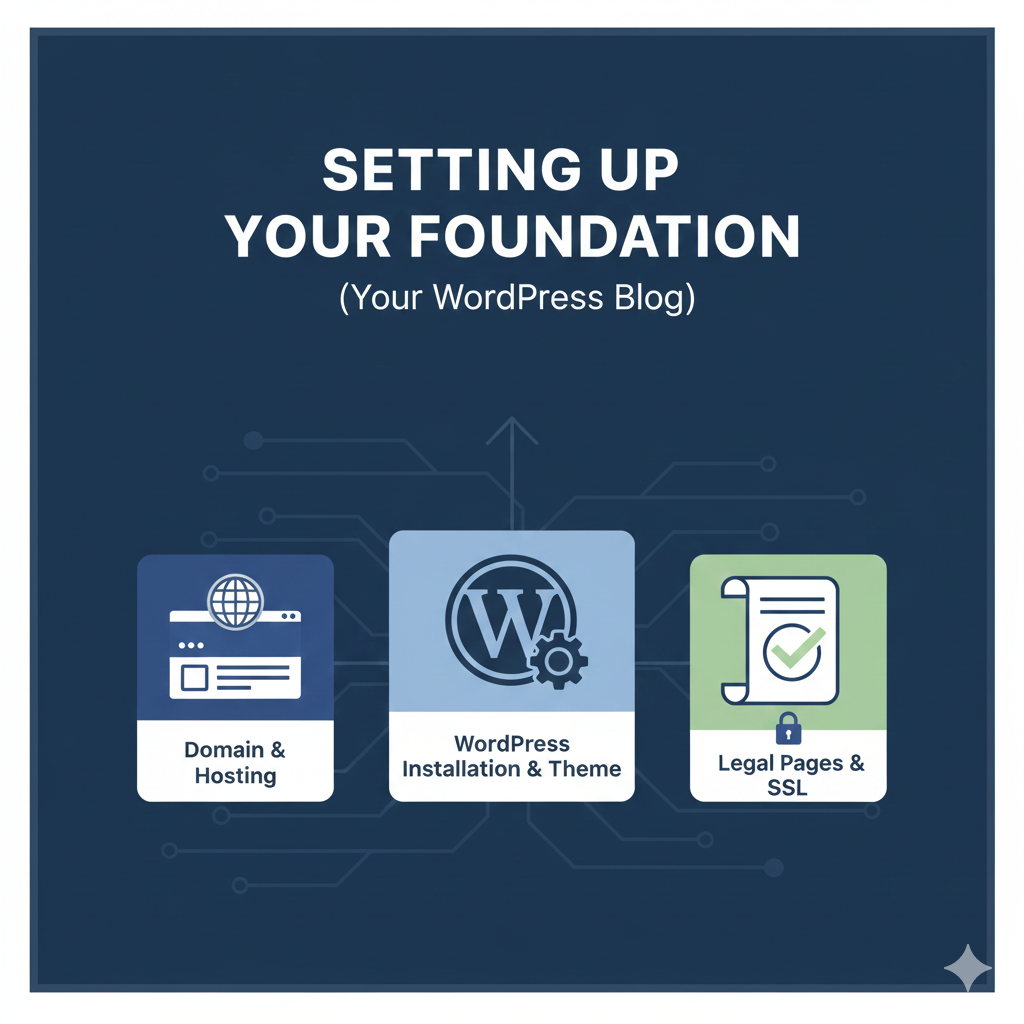
You need a professional, reliable platform. This is why a self-hosted WordPress blog is non-negotiable.
Domain and hosting: Select a hosting provider like Bluehost or SiteGround and register a domain name that suggests your niche. Keep it simple and brandable.
WordPress Installation: Install WordPress—most hosts offer a one-click install.
Theme & Design: Use a clean, fast-loading theme (like GeneratePress or Astra). Speed is a major SEO ranking factor. Conversions suffer from clutter.
Legal Pages (CRITICAL): Amazon requires you to have a Privacy Policy and a clear Affiliate Disclosure. Don’t skip this. A simple disclosure at the top of every post with affiliate links is a must: “As an Amazon Associate, I earn from qualifying purchases.”
Image Placeholder 1 (Above Setting Up Your Foundation): Prompt: A simple, clean, modern flat-design graphic showing three interconnected icons: a website/globe icon, a shopping cart/Amazon icon, and a money/dollar sign icon, representing the foundation of an affiliate business.
3. Getting involved in the Amazon Associates Program
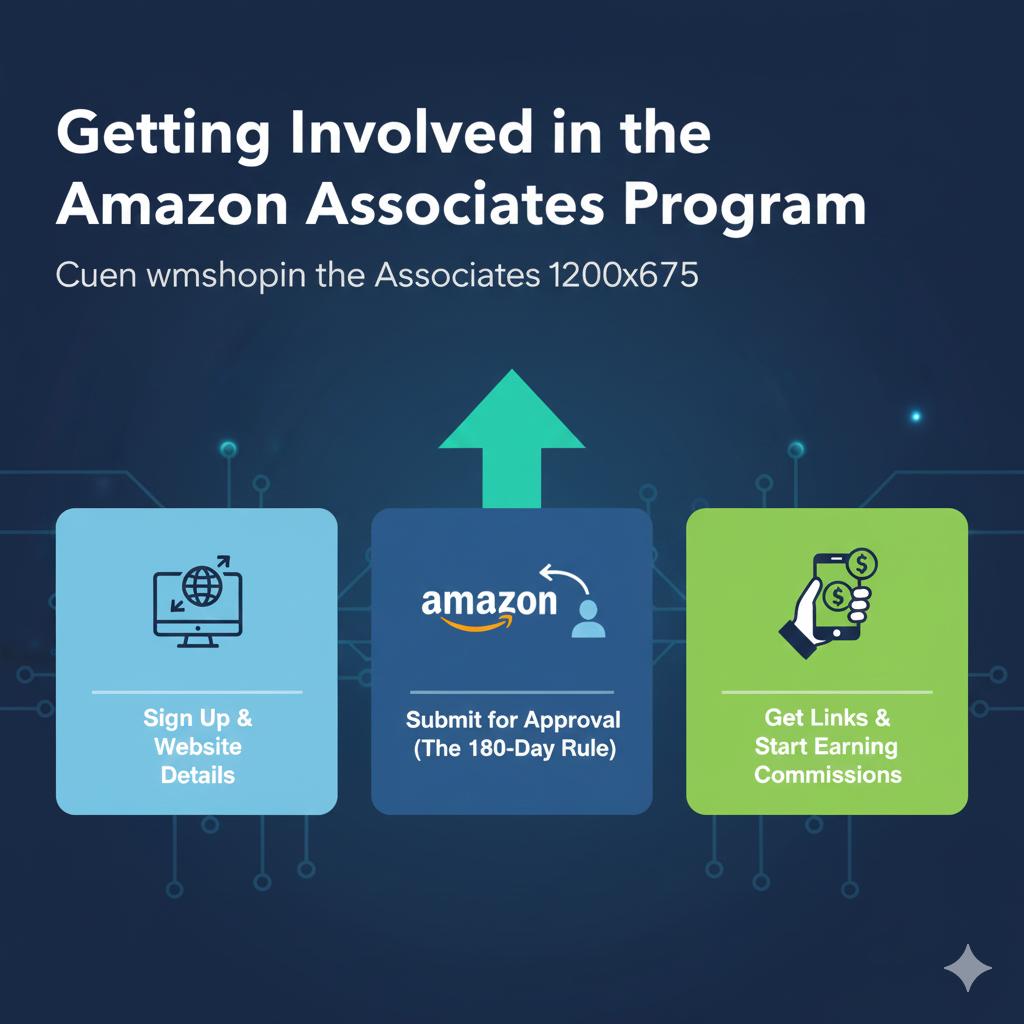
This is the easiest step, but one where beginners often stumble on the requirements.
Visit Associates Central: Go to the official Amazon Associates page and sign up with your existing Amazon account or create a new one.
Enter Your Information: Provide information about your account, including the URLs of your website or platform (your brand-new blog!).
Describe Your Website: This is a key step where you describe your niche, how you will drive traffic (SEO, social media, etc.), and what types of products you plan to promote. Be honest and clear.
The 180-Day Rule: You must generate at least three qualifying sales within the first 180 days of being approved, or your account may be closed. This is Amazon’s way of ensuring you’re serious.
Pro-Tip to Pass the 180-Day Rule: Focus your first few articles on products you already own and love. Write genuine, in-depth reviews and share them with friends and family (without forcing them to buy). This low-hanging fruit can get you those crucial first three sales quickly.
The SEO and Content Strategy in Phase 2 (Authority and Trust)
4. Keyword Research: Targeting Buyer Intent

This is where the expert strategy comes in. We don’t just want clicks; we want buying clicks. We target keywords that indicate high buyer intent.
Commercial Intent Keywords (Your High-Conversion Goldmine):
“Best [Product] for [Specific Use/Problem]”: e.g., “Best noise-cancelling headphones for open office”
“[Product A] vs [Product B]”: e.g., “Keurig K-Elite vs K-Duo comparison”
“[Product Name] Review”: e.g., “Eufy RoboVac 30C review”
“Top [Number] [Product] [Year]”: e.g., “Top 10 gaming mice 2025”
Informational Keywords (Your Traffic & Authority Builder):
“How to [do something with a product]”: e.g., “How to clean a cast iron skillet”
“What is the best way to [achieve a result]”: e.g., “What is the best way to grind coffee beans at home”
Strategy: Create a content mix. Target the high-intent Commercial keywords first to generate early sales. Then, write Informational content to build topical authority and drive non-buying traffic that you can later convert.
5. Making Amazon Affiliate Content That Converts Well
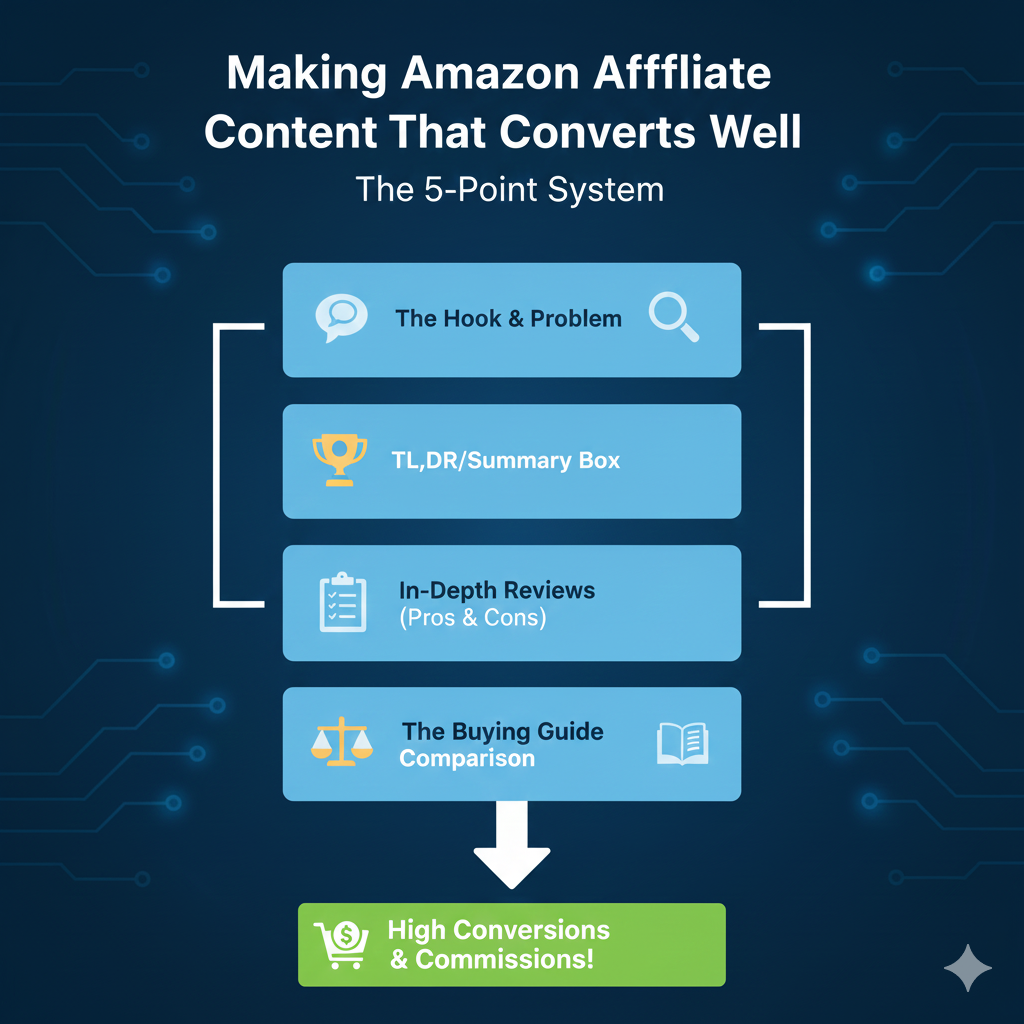
Your content can’t just be a list of features copied from Amazon. It must be better, more trustworthy, and more helpful.
The Five-Point Structure of a Successful Review Post: The Hook/Problem: Start by validating the reader’s problem. “Tired of flimsy desk chairs that ruin your back? I get it. After evaluating fifteen models…”
The TL;DR/Summary Box (High-Converting Element): Right at the top, place a clear, concise summary box showing your Top Pick and Budget Pick, with their pros/cons and a clear, non-ugly affiliate button (“Check Price on Amazon”). Many buyers just want a quick answer; give it to them immediately.
In-Depth Reviews (The Trust Builder): For each product, go deep. Mention the User Experience (how it feels, sounds, lasts), not just the specs. Crucially, mention both Pros AND Cons. Honesty is your biggest conversion tool. There is no perfect system. The Buying Guide (The Authority Boost): Include a section titled, “How I Choose/What to Look for in a [Product]”. Discuss features, materials, and price points. This is your chance to show expertise and answer long-tail questions that Google loves.
The Final Verdict/Comparison: Reiterate your top recommendation and compare it to the runners-up, summarizing who each product is best for (e.g., “This one is best for travelers; this one is best for home use only”).
Image Placeholder 2 (Within Content Strategy): Prompt: A detailed screenshot placeholder showing a “Summary Box” or “Comparison Table” section of a product review, with clear product images, pros/cons bullet points, and a prominent call-to-action button.
6. The Power of On-Page SEO and Link Placement
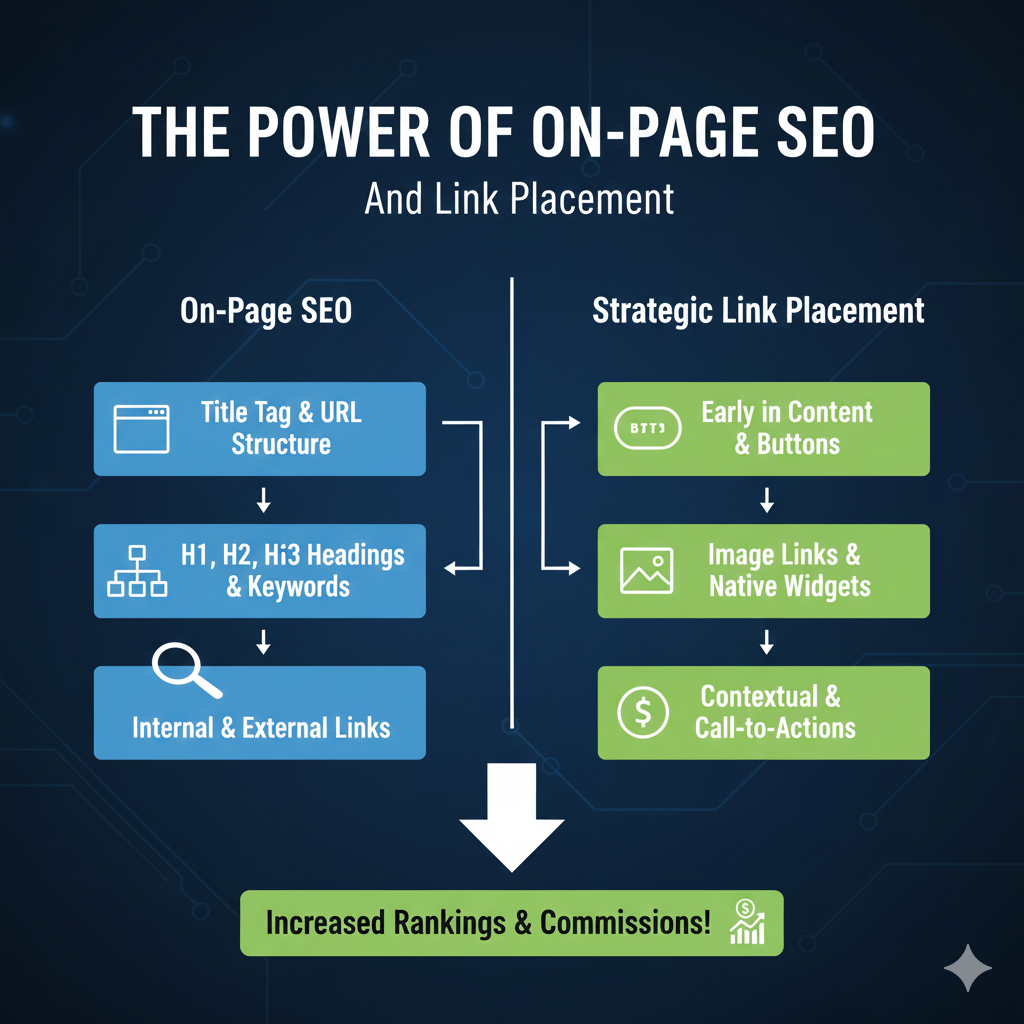
Title Tag & URL: Include your full focus keyword (“how to start affiliate marketing with amazon for beginners”) naturally in your title and URL slug.
H1 & H2 Tags: Your H1 should be your title. Use H2, H3, and H4 tags to break up the content and include variations of your keyword and related terms.
Internal linking: Link to other articles that are relevant to you. This keeps people on your site (better for SEO) and increases the chance of them clicking an affiliate link.
Affiliate Link Placement: Don’t just place a link in one spot. Place it:
On the button in the Summary Box. As a text link early in the review.
As an image/native Amazon link within the review (use SiteStripe for compliant images/widgets).
As a final call-to-action at the end of the product section.
Phase 3: Compliance, Tools, and Scaling
7. Keeping to the Rules: The Amazon Policies I Never Break

Amazon is strict, and violating their Operating Agreement is the quickest way to lose your income.
Always Disclose: As mentioned, your affiliate disclosure must be clear and prominent.
No Price Mentioning (Unless Dynamic): You should never manually write a price in your content, such as “The chair is $150.” Prices change. If you must show the price, use one of Amazon’s Native Shopping Ads or a compliant WordPress plugin that dynamically pulls the real-time price using the API.
Use Compliant Images: Do not simply right-click and save an image from Amazon’s product page. You must use the images and widgets provided by the SiteStripe tool or the Product Advertising API (PA API).
You can use a link shortener, such as a WordPress plugin that makes yoursite.com/go/product redirect to Amazon, to create cleaner URLs, but it cannot hinder Amazon’s ability to identify where a click originated.
8. Tools I Use A Lot (The WordPress Toolkit)

To start, you don’t need expensive tools, but once you begin to scale, these are game-changers:
SEO Tool (Keyword Research): Ahrefs, SEMrush, or even the free Google Keyword Planner. Knowing your competitors’ top pages is vital for content ideas.
Amazon Affiliate WordPress Plugin (AAWP or Lasso): These tools allow you to create stunning, compliant comparison tables, product boxes, and up-to-date pricing widgets without touching code. They are a worthwhile investment when you start making sales.
Google Analytics & Google Search Console: Use these free tools to track which articles are getting clicks and where your audience is coming from. This data is the secret sauce for scaling.
9. The Scaling Roadmap:

What Comes After Your First Commission
Getting those first sales proves your model works. Now, you scale strategically:
Rinse and Repeat: Double down on the content types and keywords that are already converting. Write a list of “Best under $200” if your “Best under $100” list did well.
Build the “Moat” (Topical Authority): Go back to your informational keywords to construct the “Moat,” or authority in the topic. Start writing the “How-To” and “Why” articles to surround your high-converting reviews. This signals to Google that you are the ultimate authority in your niche.
Diversify Traffic: After you have started SEO, look into a secondary source of traffic. This could be a YouTube channel or a strategy for Pinterest, which is great for visual niches like Home and Beauty. Never rely on a single platform.
Conclusion: Your Journey Starts Now
The path to building a successful Amazon affiliate marketing business is one of persistence and strategic focus. You now have the expert-level blueprint: from drilling down into a profitable sub-niche, setting up a compliant WordPress foundation, to publishing high-intent, trustworthy content that converts.
Stop overanalyzing the rivals. The market exists because they exist. Your willingness to be more helpful, more honest, and more committed to the long game is to your advantage.
Affiliates who consistently show up with genuine recommendations are the most successful. Your role is not a salesperson; your role is a trusted advisor. If you accept that, commissions will come your way. Good luck—I’ll see you at the top of the SERPs.
Most Commonly Asked Questions
Q1: How long does it take for someone who is new to Amazon Associates to start earning money?
A: Based on my experience, a dedicated beginner following a strict SEO and content plan can expect to see their first few commissions within 3 to 6 months. It typically takes nine to 18 months for a significant, regular income. The speed depends heavily on niche competition, content quality, and consistency (aim for 2-3 quality posts per week initially). In this industry, patience is a must.
Q2: What is the most important rule that novices break that prevents them from joining Amazon Associates? A: Using Amazon’s product images incorrectly (by right-clicking on them and saving them) or not providing a clear affiliate disclosure are the most common mistakes. Never use affiliate links in private emails, PDFs, or private social media groups, as Amazon cannot track the source. Always use the SiteStripe tool for images and links, and always disclose.
Q3: What is the ‘Amazon cookie’ and why is it important?
A: When a user clicks on your affiliate link, a small piece of data known as a “cookie” is saved in their browser. The Amazon Associates cookie lasts for 24 hours. This means that you still get a commission on their entire shopping cart if the user clicks your link, doesn’t buy the linked product, but buys another Amazon product within that 24-hour window. Compared to many other affiliate programs, this offers a significant advantage.
Q4: Should I purchase the item prior to writing a review? A: Ideally, yes, as personal experience drastically increases trust and conversion rates. However, if that is not feasible for every product, you must conduct extensive research. This includes reading hundreds of customer reviews, watching YouTube reviews, and checking the manufacturer’s manual. Your review must provide unique insight that is not already available on the Amazon product page to be valuable (and compliant).
Q5: Before I can apply to Amazon Associates, how many articles must I have published? A: Although Amazon does not specify a specific number, I recommend that, prior to applying, at least 10-15 high-quality, in-depth articles be published and indexed by Google. This demonstrates to Amazon that your website is active, has original content, and is ready to drive sales. The 180-day, three-sale minimum will also be easier to meet as a result of this.